
So you’re researching solid surface countertops on Google and come across these statements:
-
“If you’re wondering what is the most durable and stain-resistant countertop material, the answer is quartz.”
-
“If you’re looking for the most durable materials, look no further than granite.”
-
“…but the biggest perk of all is that marble countertops are less wear and tear than granite.”
Confused? We are, too, because the last statement isn’t true (Quartz and granite countertops are harder than marble.) These are some of the claims we found when researching kitchen countertops online. And don’t even get us started on average prices of stone countertops.
In this article, we will provide a detailed cost comparison of marble, granite, and quartz countertops to help you make an informed decision.
To clarify misconceptions, we’ve provided an estimated price range, outlined the pros and cons of each material, and offered guidance when selecting between quartz vs. marble vs. granite countertops.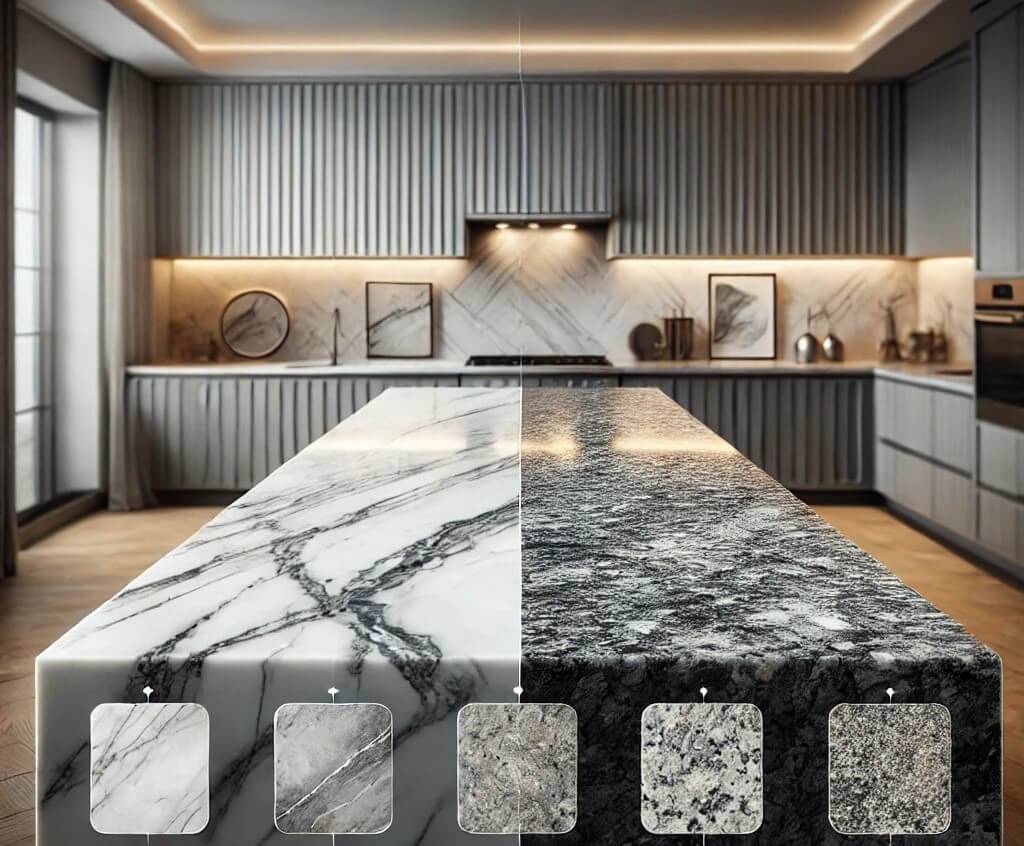
Marble vs. Granite vs. Quartz Price
We tell clients that the price range per square foot for these materials works like this: quartz < granite < marble, but it’s not set in stone (no pun intended).
-
Quartz: $45 – $100+ per square foot
-
Granite: $60 – $150+ per square foot
-
Marble: $60 – $200+ per square foot
Additionally, installation costs can vary significantly depending on the complexity of the project and the location.
Stone quality, fabrication, installation, project scope, and location affect the price. For example, laying down a single rectangular marble countertop is simpler than fabricating quartz countertops around a kitchen sink. If you’re lucky, you may find a slab of granite on sale that’s cheaper than newly manufactured quartz.
Please contact our team for a more accurate quote to discuss your project details and countertop preferences. With our help, you can create a realistic budget and may even be inspired by the work we’ve done for previous clients.
The Luxurious Allure of Marble Countertops
Before the Industrial Revolution, most kitchens were made from wood, brick, and flagstone. They were utilitarian spaces for cooking, sewing, and washing clothing. Only during the Industrial Revolution, when quarrying, transporting, and processing methods improved, did marble become more affordable to wealthy Gilded Age Americans. And even then, its purpose was functional—to keep pantry goods cool and roll out pastry. Marble has always been considered a luxury material, prized for its timeless beauty and elegance.
The 1980s saw a major shift in American kitchens. While laminate and vinyl reigned supreme in the mid-20th century, a new design wave embraced the beauty of natural materials. Marble, once overshadowed by these synthetic materials, experienced a popular resurgence. It quickly became a coveted element, and its timeless elegance has ensured its place as a perennial favorite in kitchens.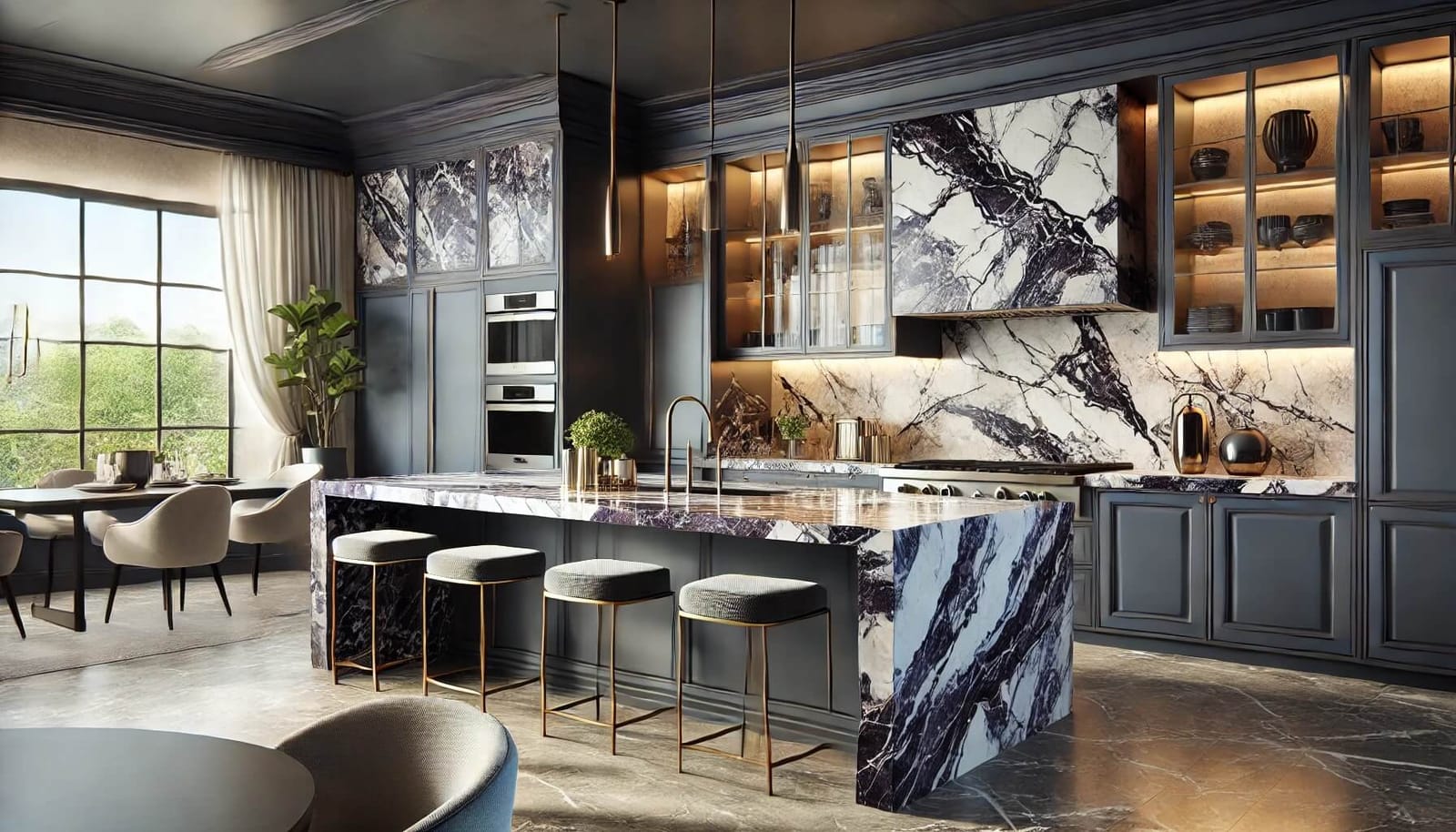
How is marble formed?
Marble is a metamorphic rock that’s created when limestone is exposed to high heat and pressure. Most marble is white due to its high calcite content; however, other minerals can color it. For example, iron makes marble pink, red, or even rusty-looking. Serpentine minerals turn it green, and fossils with lots of graphite create a dark, almost black marble.
Pros and Cons of Marble Countertops
Like other natural stones, marble will last more than a hundred years if maintained correctly. It’s so universally appealing that it’s difficult to find someone who doesn’t appreciate its aesthetic beauty. Marble’s downsides relate to price and maintenance.
More expensive than granite and quartz, marble costs between $100 and $200+ per square meter. Then there’s also the maintenance aspect. For the most part, this is vastly exaggerated. Marble is relatively simple to clean. However, you should wipe away spills immediately. It’s important to consider the maintenance costs, as marble requires regular polishing and sealing to maintain its appearance.
Since marble has a large calcite composition, it is porous and will absorb liquids, leading to etching. It also patinas over time. Again, this is not the end of the world, but it is something you should be aware of, given its price. For this reason, we recommend that clients who opt for this stone countertop polish it twice to three times a year to maintain its natural beauty.
Marble Countertop Grades
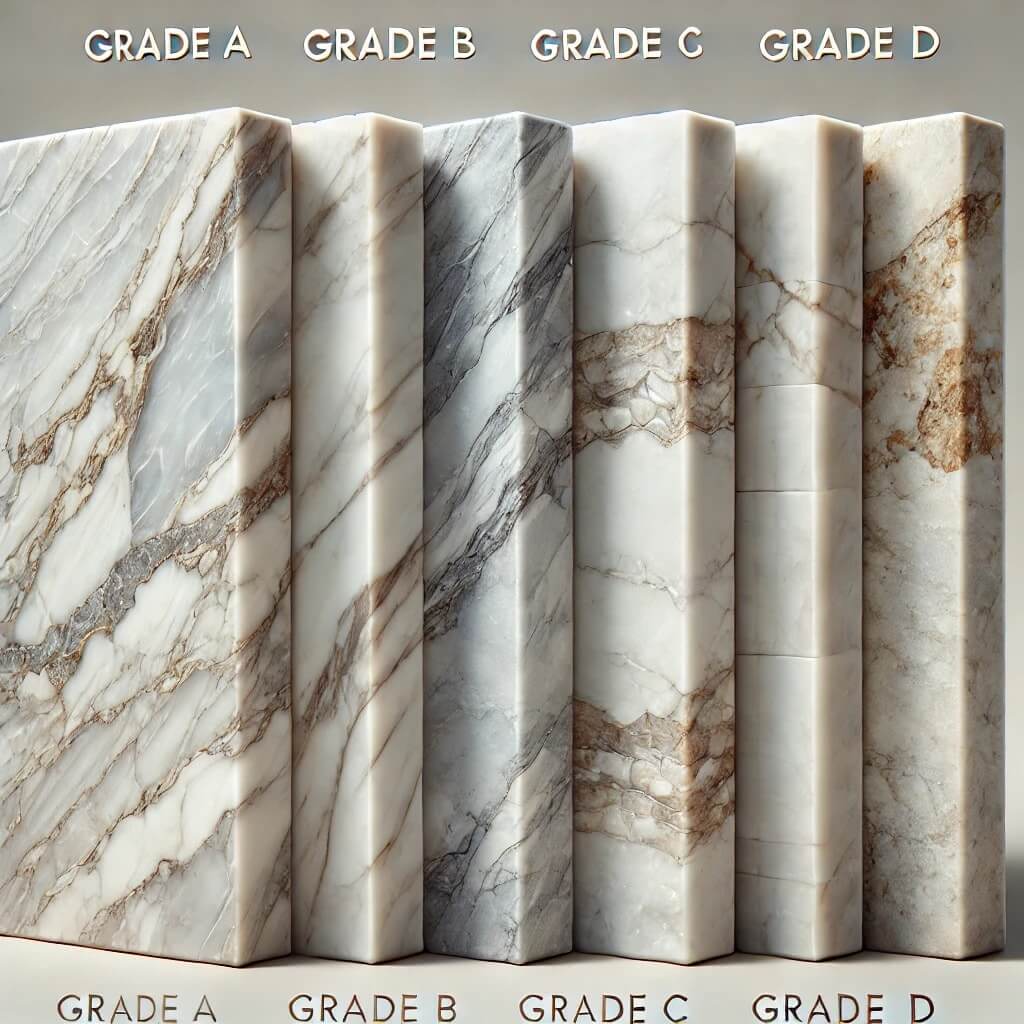
Many clients don’t know the price of marble, which is influenced by its color and veining, quality, and rareness. Marble is classified according to four grades:
-
Grade A: Surprisingly, Grade A has no prominent veining and few geological flaws, which gives it a uniform appearance. Carrara marble from Tuscany, Italy, would be classified as Grade A in its purest white form.
-
Grade B: Here, the veins are dry. In other words, they indicate a separation between the natural materials when the stone was formed. There may be some edging and minor imperfections, but these are hardly visible. White Calacatta marble with its grey and gold veining may fall under this grade.
-
Grade C: The marble has many lines of separations and some flaws that fabricators need to repair. Imperfect areas are usually repaired with stone chips and are barely noticeable once fixed. Examples include dramatic-veined marble like Statuario or Breccia.
-
Grade D: Fabricators generally use cement, epoxy, adn dowels to ensure the marble’s integrity. This grade has the most flaws, but that doesn’t necessarily make it unusable.
The Enduring Strength of Granite Countertops
The granite slab entered the modern kitchen in 1986 when graphic designer Deborah Sussman’s kitchen appeared in the New York Times with granite countertops. According to Vox, the following year, “it was singled out as a cutting-edge material in the Los Angeles Times, but still expensive for most people. Throughout the 80s, it was still jockeying with marble for favor among California yuppies.” Granite has become a cost-effective option for many homeowners looking for a durable and attractive countertop material.
Since Reagan’s heyday, shipping methods have improved, and computerization has made granite slabs easier to cut. As a result, granite countertops, more so than marble, have become ubiquitous in kitchens in the United States. By 2014, 49% of suburban homes in the U.S. had granite countertops.
How is granite formed?
Deep within the Earth’s crust, molten rock called magma cools and crystallizes under immense pressure to form igneous rock. Over millions of years, wind and water erosion wear away at the Earth’s surface, bringing this igneous rock, also known as granite, closer to our reach.
Granite quarries are found in several states in the United States, including Texas, Indiana, Massachusetts, Wisconsin, and Georgia. However, the global nature of the stone trade allows us to explore stunning varieties imported from Canada, India, and beyond.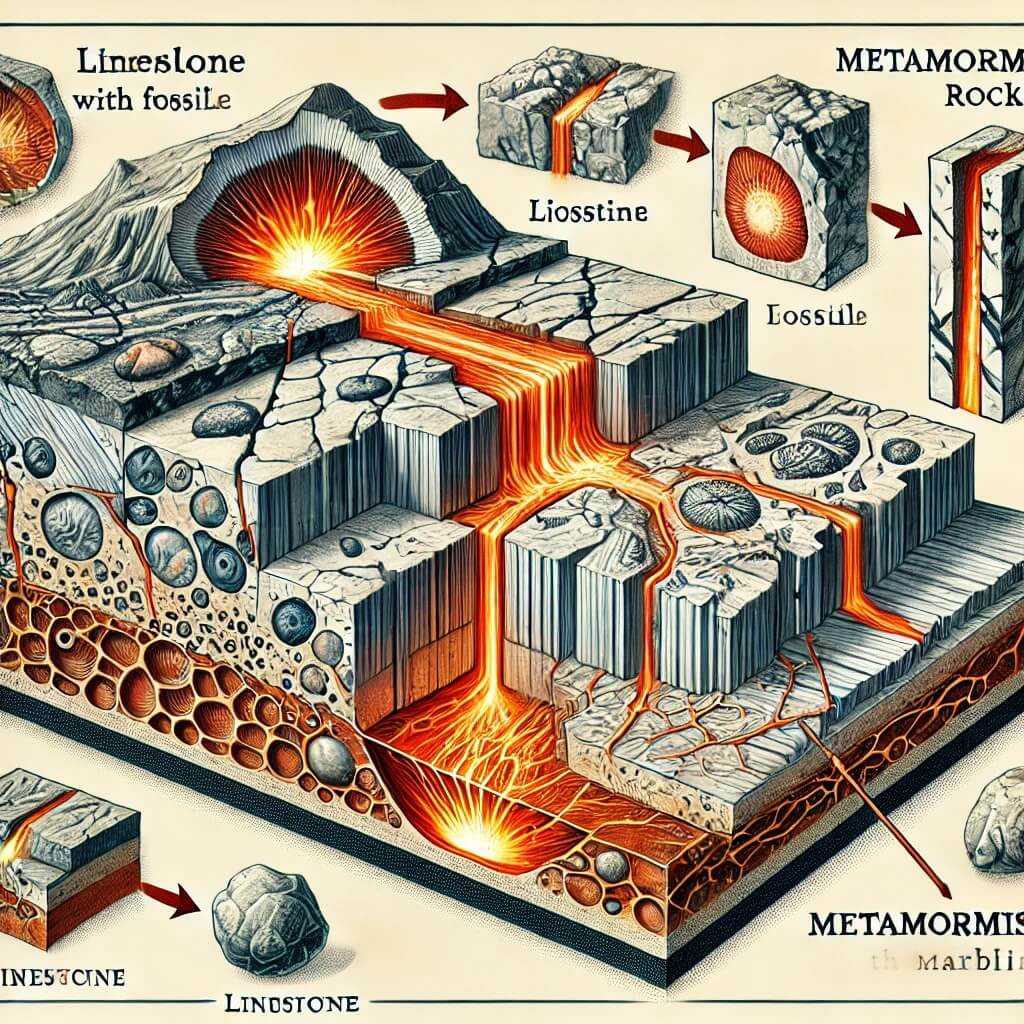
The Pros and Cons of Granite Countertops
Granite countertops are renowned for their durability, measuring a 7 on the Mohs Hardness scale – surpassing the toughness of many kitchen knives! Even though a stray knife scratch won’t be visible on the granite, it can harm the sealant and blunt the knife. This particular stone is harder than marble, which makes it perfect for bustling kitchens. With proper upkeep, granite can last for over thirty years. It is a durable option that offers enduring functionality and beauty.
So, what’s the downside? Granite requires consistent sealing to defend its surface against bacteria and staining. Depending on the type of granite and kitchen design, one or two seams connecting different slabs may be visible. Although granite appears cheaper than marble, it is pricier than laminate or ceramic tile, with prices ranging between $40 and $100+ per square foot.
Granite Countertop Grades
Manufacturers and suppliers grade granite into different levels according to thickness, porosity, origin, and appearance:
-
Level 1: Also called builder’s grade, entry-level granite is quite thin (less than 2cm) and has a limited palette – mostly white, beige, gray, and brown. It’s mainly used in budget-friendly projects and rental projects. Examples include Baltic Brown and Uba Tuba.
-
Level 2: Generally 3cm, mid-grade granite offers a wider variety of colors and more unique patterns. It’s best for residential kitchens and bathrooms. Giallo Ornamental and Blue Pearl are common types.
-
Level 3: Granite slabs graded 3+ are premium quality, offering rare patterns, superior thickness, and exotic colors. You’ll find them in luxury residential homes. Two examples are Lapidus and Magma Gold.
The Versatile Appeal of Quartz Countertops
Quartz countertops were created in the 1960s with the introduction of “Breton stone technology” by an Italian company. The manufacturing procedure involved mixing crushed quartz with resin and pigments to create a long-lasting countertop material. At first, quartz was promoted as a durable substitute for natural stone choices such as granite and marble. Quartz quickly became an affordable option for homeowners seeking a durable and low-maintenance countertop material.
While it took off in Europe in the 1960s and 1970s, American homeowners weren’t as sold on it as they were on laminate, vinyl, and tiles. Only in the 1990s, when new manufacturing techniques emerged, and companies could produce quartz in various colors and patterns—even mimicking natural stone—were homeowners convinced. The bonus? It was cheaper and had lower maintenance.
How is Quartz Made?
A quartz countertop might seem like a solid chunk of colorful minerals, but it results from some clever material science. It’s made by pulverizing quartz into tiny particles that comprise around 90% of the final slab. Manufacturers combine it with resins and polymers—a super glue for countertops—to create a strong, solid surface that can handle the chaos of a busy kitchen.
Next, pigments are introduced to create solid colors, mimic the luxurious look of marble or granite, or even design unique speckled patterns. Once the perfect shade or design is achieved, the mixture is pressed into slabs using specialized equipment or molds.
Then, the surface is polished to a high shine for a sleek look or honed for a more textured feel. Finally, the slabs undergo rigorous quality control checks to meet strength, consistency, and visual appeal standards.
The Pros and Cons of Quartz Countertops
There’s a lot to like about this engineered stone: it’s scratch—and stain-resistant, non-porous, and very low maintenance. A mixture of mild soap and water keeps it looking clean. So, again, what’s the catch?
As we’ve established, it’s not 100% natural stone. Sometimes, depending on how sophisticated the veining is, it can look fake when mimicking granite or marble. Direct contact with hot pots and pans also causes discoloration.
At the same time, we don’t recommend anyone put their hot cookware on any countertop without trivets. Most stone counters are heat resistant, not heatproof (Heat resistance doesn’t mean they’re 100% heat-proof). Lastly, prolonged sun exposure can discolor them—something to consider if there’s lots of natural light in the room.
The Difference Between Quartz and Quartzite
Yes, they’re not exactly the same thing.
-
Quartzite: A natural stone, quartzite boasts unique patterns, like a geological fingerprint created by nature. This inherent variation means each slab is one-of-a-kind. If a uniform look is your priority, purchasing all the quartzite you need from the same block at once is best.
-
Quartz: This engineered stone offers incredible consistency. Made from 90% crushed quartz with resins and pigments, manufacturers control the colors and patterns. This translates to a designer-controlled aesthetic – the look you choose today will be nearly identical if you buy more later. Quartz is also slightly more durable than quartzite.
How to Choose the Best Countertop Materials
Again, there’s no right or wrong. These questions will help you consider what will serve you best in your home’s busiest areas.
-
How meticulous are you when it comes to cleaning countertops?
-
How important is stain resistance to you?
-
Is scratch and heat resistance important?
-
What aesthetic are you after? Do you have a specific color or pattern preference?
-
How busy is your kitchen? Do you cook frequently and need lots of counter space?
-
Are you looking for a budget-friendly option that still offers durability and aesthetic appeal?
-
Do you have a deadline? (Sometimes natural stone has to be imported.)
-
How concerned are you about countertop seams?
-
Are these countertops for a rental property or your home?
Work With Boss Design Center, Your Natural Stone Experts
We hope this information sheds some light on quartz, marble, and granite countertops. Although we’ve spoken exclusively about kitchen countertops in this blog, all three options are suitable for bathroom vanities. Again, it comes down to personal preference, budget, and lifestyle.
We’re all ears if you’re mulling over countertop options and need expert advice. Boss Design Centre has built and remodeled many bathrooms and kitchens with granite, marble, and quartz countertops. We know what makes each material tremendous and challenging. Most importantly, our design team knows how to bring out the best qualities of each material.
Chat with us today! We’d love to help bring your project to life.