
There are hundreds of options, each promising a unique aesthetic and performance. But, unlike a scatter cushion or barstool, a poorly chosen kitchen floor can’t be easily returned or swapped if you have regrets or second thoughts.
Kitchen floors are permanent fixtures that require deliberation, especially since they can increase your home’s value by 10%-54%. With that in mind, we’re sharing (honest) advice about different kitchen flooring options so you can make an informed opinion when creating your home’s culinary hub. Kitchen floor tiles, including materials such as stone, ceramic, and porcelain, offer various features, colors, patterns, durability, and maintenance requirements, making them suitable for kitchen floors.
Read on to find out how to choose kitchen floor material, what makes hardwood the best flooring for a kitchen, and why carpets and vinyl are some of the worst.
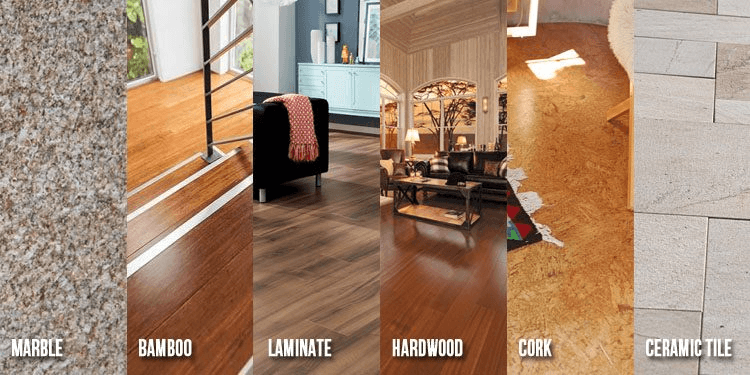
How to Choose the Best Floor for Your Kitchen
From budget to comfort and lifestyle, there are a few things to consider before deciding on the best floor for your kitchen.
Lifestyle
You’ll need a robust and durable floor if you have kids and pets. Live in a colder climate? You might want to invest in a warmer material like wood and steer clear of tiles. Consider your lifestyle needs first and foremost.
Budget
Are you building a home from scratch, where flooring is just one expenditure among many?
Or are you focusing solely on a flooring upgrade, allowing for a bigger budget? To give you an idea, the national average for installing hardwood floors is $3 to $13 per square foot.
Comfort
You’ll want a comfortable floor since so much walking and standing takes place in kitchens. Wood tends to be more forgiving on joints than stone, concrete, or porcelain, and it looks and feels warmer. Cork flooring is another comfortable option due to its soft and springy feel, although it is not waterproof. Then there’s also the safety factor – ceramic and marble floors are slippery, for example.
Maintenance
Flooring materials have various maintenance needs. For instance, stone floors need regular cleaning to eliminate grime in grout lines, whereas laminate flooring is far easier to clean but might not last as long. Always ensure the floor’s cleaning requirements match your lifestyle.
Home Aesthetic
Choose flooring that compliments your kitchen and home interior. Do you have a seaside aesthetic, or is minimalism your thing? Consider the room size, existing textures, patterns, and colors. Do you want your kitchen floor to be a neutral surface or a focal point?
Signs Its Time to Upgrade Your Kitchen Floor
Signs it might be time for a flooring upgrade:
-
Style stuck in the past: A dated floor may clash with modern appliances or a new paint update.
-
Life changes: More people or pets mean more wear and tear. Because of their resilience, the EPA recommends replacing softwoods with tile, ceramic, or harder wood.
-
Stubborn stains: Food spills can leave permanent marks. If a deep clean fails, consider replacing the affected area.
-
Safety risks: Uneven floors, cracks, or raised edges pose a fall risk.
-
Boosting your home’s value: A dated kitchen with worn floors is a turn-off for potential buyers. Investing in a makeover, including new flooring, can increase your asking price.
The Best Kitchen Flooring Options
Finding the perfect balance of style, functionality, and comfort is essential when selecting kitchen flooring. Here are a few options for your consideration:
Solid Hardwood Flooring
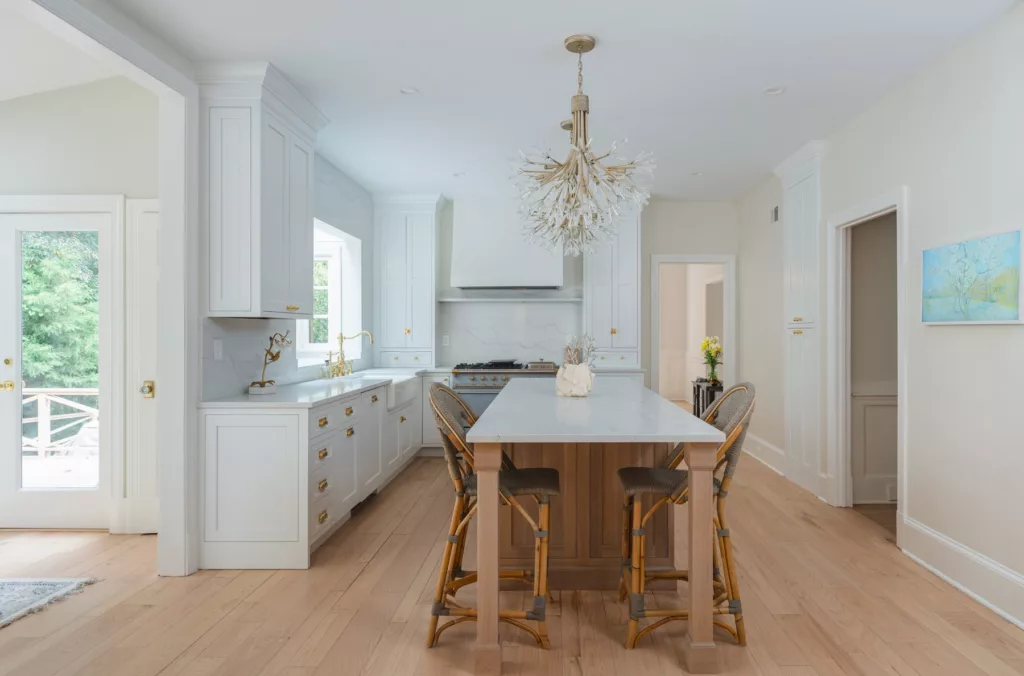
While ceramic or porcelain tiles are the most popular flooring for kitchens, we think solid hardwood is the best floor for your kitchen. The majority of homes in the U.S. already have solid wood floors.
Some people hesitate to install a wood floor in their kitchen due to concerns about moisture and durability, but modern finishes and proper maintenance can address these issues.
So, installing solid wood continues this trend and maintains visual consistency. You also don’t need to install molding between different flooring materials, and nowadays, homeowners steer away from too many textures and thresholds on floors.
There are other advantages, too:
-
Timeless appeal: Hardwood flooring doesn’t go out of style. There are many wood options, colors, and finishes.
-
Durable: With the correct maintenance, solid hardwood floors last up to 100 years, while engineered hardwood floors last almost 50 years.
-
Long-lasting: Can be refinished many times (usually every 5-7 years), meaning it can potentially last the lifetime of your home.
-
Sustainable: Made from 100% natural materials and eco-friendly.
-
An investment: Adds up to 2.5% more value to your home.
-
Comfort and warmth: Wood is a natural insulator compared to tiles and concrete.
Types of Solid Hardwood Floor
-
Red and White oak is easily accessible. The majority of the old houses have those either way, so matching it or finding pieces for patching is very straightforward.
-
Maple flooring is also a good option, it doesn’t have the strong veining and variation like oak and provides more uniform color and texture on the floor
-
Chery! Yes, we do still see some old cherry floors in the project we do renovate! Sunburn is the biggest enemy of the cherry flooring but it comes with beautiful strong variations.
Porcelain Flooring
Porcelain is pressed and fired at high temperatures, making it a less porous and more durable floor option than other clay-based options like ceramic or porcelain tile. While technically stronger than hardwood flooring, it cannot be refurbished, so if it goes out of date or you want a new look, you will have to gut your entire floor.
Porcelain tile is harder and more water-resistant than ceramic tile, does not need to be sealed, and wears better than ceramic tile.
In wood-frame houses, natural settling can occur over time. Even though porcelain tiles are very strong, this movement could potentially lead to cracks in the grout or, in extreme cases, the tiles themselves.
Like hardwood flooring, porcelain tiles do have benefits:
-
Durable: Tough and resistant to scratches, dents, and chips, which makes it perfect for pets.
-
Water resistant: It does not absorb water, making it a good option for homes in high-humid climates.
-
Low-maintenance: Its non-porous surface resists grime and dirt build-up and is easy to clean.
-
Long-lasting: With proper care, porcelain tiles can last over 60 years.
Nowadays, we do prefer large format porcelain flooring in the kitchen such as 24×48 or 48×48. This requires proper underlayment, potentially a double plywood subfloor or Schluter DITRA. Because tiles are very large format, we do not end up with a lot of grout lines which are not ideal in highly traffic areas. Also large format porcelain flooring gives slab look, and definitely looks way more luxury than smaller mosaics.
Slate Flooring
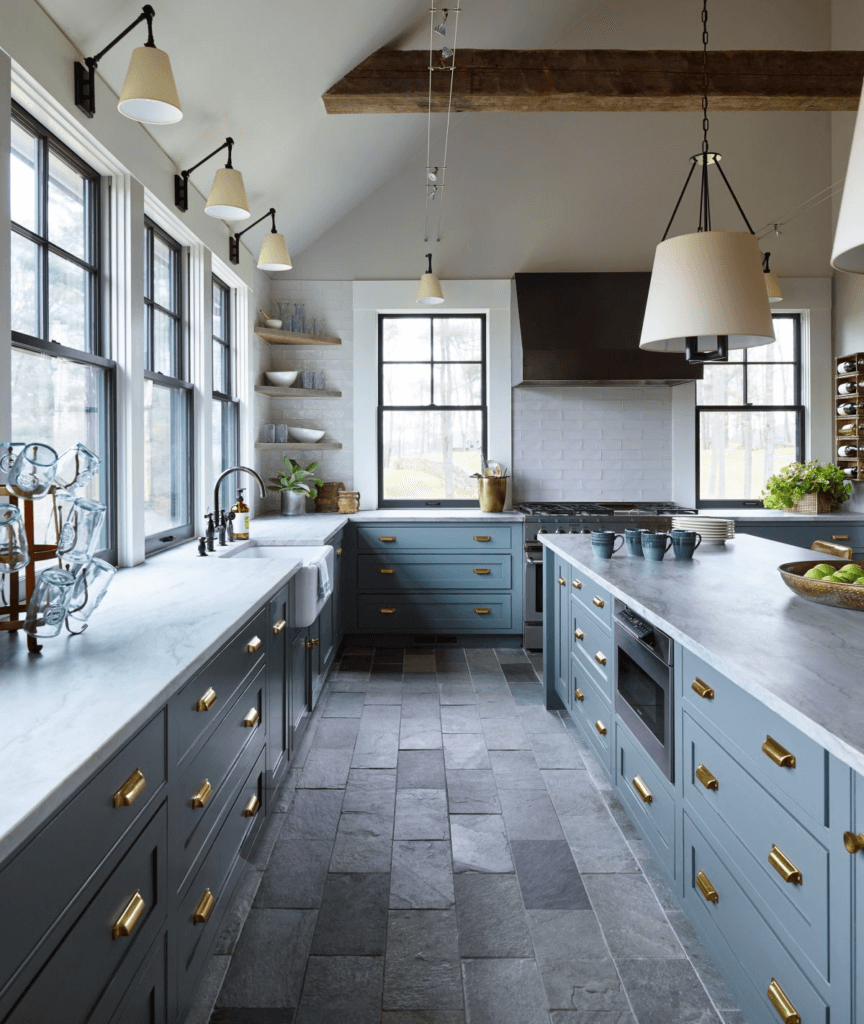
Slate is the most affordable natural stone kitchen material, costing between $4 to $28 per square foot. Available in grey, multi-colored, natural shades, and black, each tile has unique veining and patterns that give off a rustic, earthy appearance.
Stone tile is a durable and luxurious kitchen flooring choice, with natural stone options like granite, marble, slate, or travertine. These high-end materials are tough and come in a variety of tones, though they require periodic sealing to protect against stains.
While generally low-maintenance, slate does need sealing once a year to maintain stain resistance and UV fading. (Intense sunlight can cause slate to lighten over time.) Just like porcelain, if you have a wood-frame house, the natural setting can lead to cracks in the grout.
The pros of slate kitchen floors:
-
Durability: Hard, strong, and resistant to scratches, cracks, breaks, and chips.
-
Thermal properties: Absorbs and retains heat.
-
Low maintenance: Its smooth and non-porous nature makes it easy to clean.
-
Fire-resistant: Slate is primarily made of quartz, mica, and chlorite—fire-resistant materials that won’t ignite or burn at high temperatures.
-
Recyclable: Slate can be reused in landscaping applications if not for another floor.
Engineered Hardwood Flooring
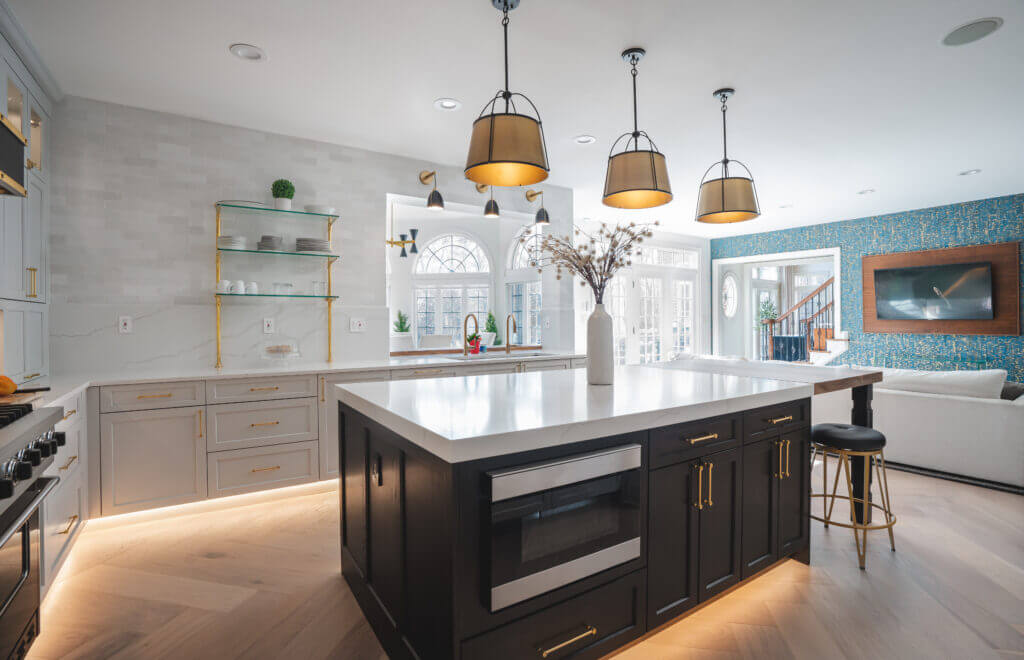
Engineered hardwood flooring consists of plywood or MDF (medium-density fiberboard) topped with a layer of real wood—typically walnut, maple, oak, or a similar variety. Depending on the product and quality, it can be 20%—50% cheaper than solid hardwood.
However, there are two major downsides. Firstly, the top layer of wood is thin, which makes refurbishing difficult, if not impossible. Secondly, it’s not waterproof and can warp and buckle when wet.
Engineered vinyl flooring is a practical and versatile option that mimics the look of hardwood floors, is completely waterproof, easy to clean, and has a springy feel underfoot.
Otherwise, homeowners choose engineered wood for the following reasons:
-
Temperature and moisture resistant: It’s not as sensitive to the elements as solid wood flooring.
-
Easy to clean: A vacuum cleaner or broom and damp mop is all you need.
-
Simple installation: An easy tongue-and-groove system ensures boards fit perfectly together.
-
Environmentally friendly: It uses less solid wood and is more eco-friendly than hardwood.
Quartzite Flooring
Quartzite is what happens to sandstone when it’s heated and compressed. It’s harder than granite, and some varieties resemble marble, so it’s no wonder it’s become a popular kitchen floor option.
Quartzite doesn’t lose its luster over time. Instead, it develops a richer patina, enhancing its natural beauty. The only downside is that it’s prone to etching from acidic substances and is only available in limited earthy tones, white or gray.
The advantages of quartzite flooring:
-
Durability: It ranks a 7 on the Mohs scale of mineral hardness, where the diamond is a 10 (the hardest) and talc is a 1 (the softest). Therefore, it can last many years.
-
Heat resistance: Kitchens can get hot, but quartzite has low thermal conductivity.
-
Easy to clean: Resistant to viruses and bacteria. Its non-porous nature makes for a simple cleaning routine.
The Worst Kitchen Flooring Options
Want to get the most bang for your buck? Avoid these flooring types at all costs.
Laminate Flooring
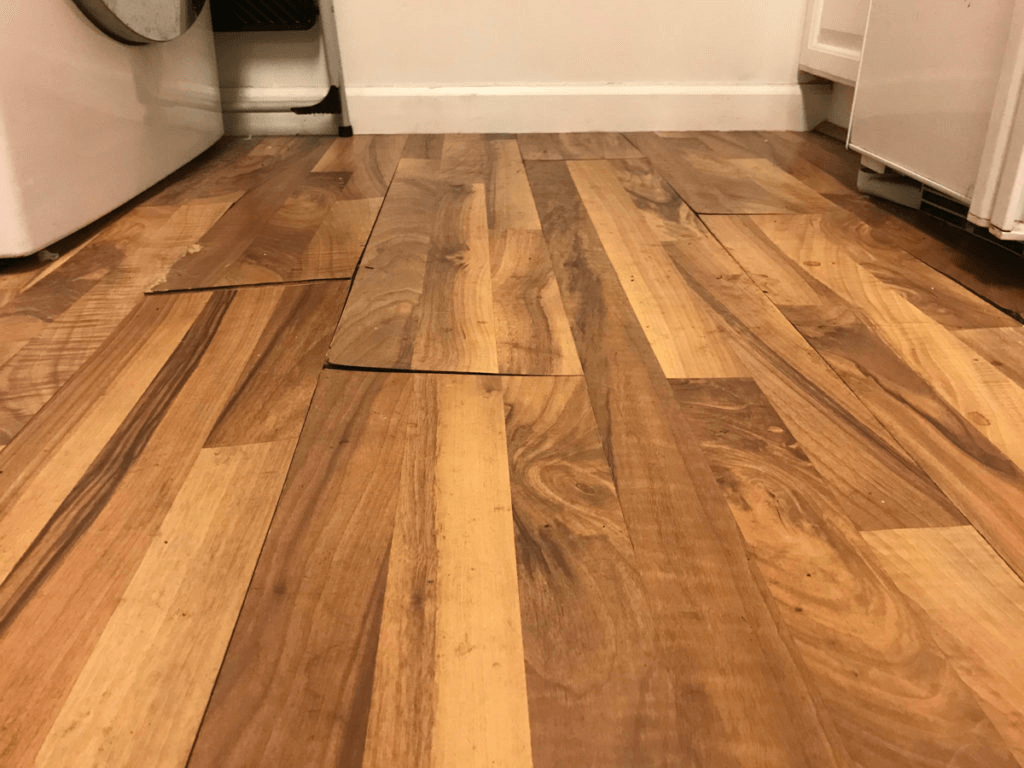
Homeowners love the look of laminate flooring because it closely imitates wood. While some laminate varieties are water-resistant, they’re not waterproof, so its biggest disadvantage is moisture vulnerability.
Thus, it can swell and warp if exposed to moisture (even humidity) for prolonged durations. Furthermore, once the floorboards wear out, you can’t refurbish them.
Other reasons laminate isn’t the best kitchen flooring:
-
Chemical sensitivity: Acidic food spills and ammonia-based cleaners damage laminate floors.
-
Temperature vulnerability: Can pull apart between grooves if exposed to extremely cold temperatures.
-
Noisy: Tends to creak and squeak underfoot when installed without a rubber underlayment.
-
Shorter lifespan: Lasts 10 -25 years, which is reasonable but not as long as hardwood flooring.
Softwood Flooring
Softwoods like pine or spruce are prone to dents, scratches, and dings from wear and tear, dropped cookware, and pet claws. Even a guest wearing high heels could damage your kitchen floor.
Sealing softwood with a few coats of polyurethane improves durability, but it’s more suitable for an attic or seldom-used guest bedroom.
Other reasons softwood is a bad idea:
-
Moisture sensitivity: Leaks, spills, and humidity can cause warping, cupping, and rotting.
-
High maintenance: Needs to be sealed and sanded more often than hardwood, depending on the traffic volume
-
Limited lifespan: Shorter lifespan than hardwoods and natural stone.
Limestone, Sandstone, or Marble Flooring
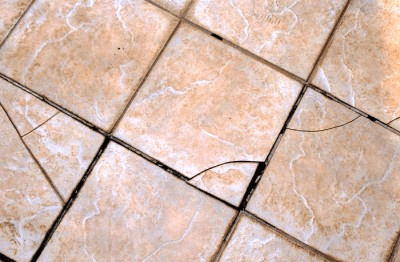
All three of these options will make your kitchen look beautiful. But aesthetics aren’t always pragmatic. Marble, sandstone, and limestone have slightly different properties, but one thing is for sure: these stones stain easily.
Wine, coffee, acid, and cleaning products can dull their luster. If a liquid seeps too deep, you’ll have to hire professionals to remove it or, in the worst-case scenario, replace the slab.
Marble, sandstone, and limestone also have their fair share of cons:
-
Slippery when wet: polished stone floors can be dangerous, especially for small children or elderly individuals.
-
Etching: Certain spilled liquids can leave dull spots or a rough texture
-
Water damage: Stone around sinks and dishwashers can warp, crack, or grow mold if improperly sealed.
-
Regular sealing: Maintenance may be needed every six months to a year.
Carpet Flooring
Carpet flooring in kitchens is just as bad as 1970s carpeted bathrooms. It isn’t hygienic and is completely unnecessary in a space filled with liquids and foodstuffs. The main reason carpets are bad is that they’re a moisture magnet.
Carpets absorb every spill and splatter and are difficult to clean completely with an industrial vacuum. They are also a breeding ground for mold and mildew growth, causing unpleasant odors and health risks.
Other reasons we’d steer clear from carpeting:
-
Dingy-looking: Grease stains make the carpeting look old and gross over time.
-
Allergens: Traps pet dander, dust mites, and other allergens, making allergies worse.
-
Thinning: Fibers wear down quickly in high-traffic areas.
Vinyl Flooring
Let’s take a moment to talk about vinyl, our least favorite option. Vinyl flooring rose in popularity in the 1960s when manufacturers made new no-wax finishes available. However, luxury vinyl, including luxury vinyl plank (LVP) and luxury vinyl tile (LVT), offers a more durable and water-resistant option for kitchens.
Luxury vinyl tile (LVT) is a practical and versatile flooring option that mimics the look of high-end materials such as ceramic, porcelain, hardwoods, and natural stone.
We get the appeal—it’s cheap, with some peel-and-stick options costing as little as $1 per square foot. It’s also waterproof, pet-friendly, has many designs, and is easy to install.
But it is not the best floor for your kitchen because its:
-
Bad for the environment: Made from polyvinyl chloride (PVC) derived from fossil fuels.
-
Looks cheap: An overly shiny, plasticky finish lacks the natural variations and textures in wood or stone.
-
Can’t be refurbished: Once it’s past its sell-by-date, you’re forced to redo the entire floor.
-
Very thin: When incorrectly installed, it creases and crinkles underfoot.
Professionals Can Help You Choose the Best Flooring For Your Kitchen
Feeling overwhelmed by too many choices? Had your heart set on laminate flooring, only to realize it may not be the best option? Don’t worry. Boss Design Center is a full-service design, build, and remodeling company that installs and upgrades kitchen flooring.
While our expert team always recommends hardwood flooring as a first choice, we can suggest other kitchen flooring options depending on your lifestyle needs and budget. Together, we’ll find the perfect foundation for your home—a floor that marries form with function and endures the wear and tear of busy kitchens.
Contact us today to find out more.